Faculty Staff Union

Representing Faculty Members and Librarians at UMass Boston Since 1976

  • Contact Us
  • Membership Info
  • Executive Committee
  • Contracts & Documents
  • Member Rights
  • Calendar Of Events

Reinstate Prof. Jones Now!

Dear FSU members,

We are launching a petition campaign in support of one of our members who has been slated for termination in what we believe is an act of retaliation for union activity and critiques of the administration. We demand that Provost Joseph Berger reinstate Professor Keith Jones NOW! 

Here is the link to the petition with the full context. Please circulate broadly across the campus community. Students are encouraged to sign as well.

In solidarity,

Your FSU Executive Committee

The Point: Academic Freedom and Public Release of Faculty Emails at UMass Boston

3/5/2026

The week’s edition was written by The Point committee.  As always, The Point represents the views of the authors and is not the official position of the FSU.

Dear Colleagues,

As you are no doubt aware, faculty across the country are facing increased pressure to self-censor or simply avoid a growing range of subjects, including DEI, climate science, critical race theory, gender studies, the Middle East, vaccines, and even women’s healthcare.  These pressures emanate from the Trump administration, reinforced by organizations aiming to undermine higher education, and interpreted and implemented by university administrators and clearly pose a direct threat to academic freedom and the vigorous sort of intellectual exchange required for advancing scholarly understanding.

We write today to alert you to an example of this at UMB, the targeting of one FSU member (so far) that has broader implications for UMB faculty, students and staff, academic freedom, privacy, and the basic ability to do our jobs as scholars and educators.

On October 9th of last year, the University received a public records request (our state-level version of a Freedom of Information Act, or FOIA, request at the federal level). The request came from “Defending Education,” a right-wing-funded organization identified back in 2021 by our international union, the National Education Association, as a radical group spreading disinformation (their website will give you a good sense of their conspiratorial, fearmongering agenda).  Defending Education requested that UMB release to them several months of Professor Karen Suyemoto’s UMB emails containing specific words, such as “Gaza” and “genocide.”  On their website, Defending Education makes clear that their “investigations” of this sort aim to collect emails to publicize in full on their site in order to encourage doxxing and other attacks from the networks of which they are a part.

To be clear, this is legal: MA public records law allows for certain types of information of this sort to be given to requestors.  At the same time, some materials, even ones captured by the search parameters, are legally exempt from release, including those containing intellectual property.  In some cases, it is even illegal to hand over these emails to third parties, given the University’s obligations under the federal Family Educational Rights and Privacy Act (FERPA).

In mid-October, Professor Suyemoto inquired of UMB administration whether she would be informed if a public records request had been filed against her, and also whether such a request actually had been filed. She anticipated that there would be such a request because a colleague who participated in the same conference panel as Dr. Suyemoto had been informed by their university of a public records request (the same one). Dr. Suyemoto did not receive a response to her question.

In fact, the University had received such a request on October 9th. However, the University did not notify Professor Suyemoto until November 21 that they had received it and simultaneously notified her that they would be releasing months of her emails with the specified words.   Once informed, Professor Suyemoto did a search of her own emails using the criteria provided and quickly informed the Administration that such a request would capture some emails including emails with students and emails about research. These emails should not, legally, be released. The University assured her it was on it, and that student emails in particular would be withheld.  No problem.

At this point, Professor Suyemoto asked if she could review what the University intended to hand over before they released it, something other universities do in order to ensure that students and faculty are protected. The FSU also requested to see the emails before they were released.

Unfortunately, the University ignored those requests and released the emails to Defending Educating without allowing review by Professor Suyemoto or the FSU.

What was released?  The University released full, unredacted emails including student information (names, email addresses, research foci), student work (proposals and papers), student evaluations, research data, and Professor Suyemoto’s personal information. In so doing, UMB violated FERPA and labor law, potentially exposing itself to lawsuits.

After releasing the emails to Defending Education, the University shared the released files with Professor Suyemoto. Her review of these emails again identified the issues she had previously alerted UMB about, as well as additional issues. When Professor Suyemoto raised these grave errors, UMB administrators initially insisted everything had been done correctly, that it had conducted a thorough review of all emails, that redactions had been appropriately made, and that student emails had been withheld.   Professor Suyemoto then identified, item by item, the particular emails that contained specific information that clearly should never have been released to a third party.

Eventually recognizing it screwed up, the University sent a revised file to Defending Education, asking the organization not to open the first one.  Yes, this was the remedy.  In other words, the University asked an organization known for spreading disinformation to not open the original file that it now had in its possession — the one with information that should never have been released in the first place.

In sum, the University did an incompetent job of reviewing the emails. It failed to allow review by Professor Suyemoto — the person best positioned to understand their content — or by FSU legal, the organization that works to protect faculty rights. In doing so it may have broken the law, and it certainly violated Professor Suyemoto’s academic freedom.

Unfortunately, these egregious, and easily avoided, errors do not seem to have led the university to rethink its processes, procedures, or policy, let alone apologize to Professor Suyemoto and the other impacted faculty and students.  UMB has, in effect, adopted a policy and practice that opens the university community to maximum possible exposure from groups like Defending Education—groups whose explicit aim is to undermine higher education. UMB has simultaneously opened itself up to lawsuits from its own employees and students.

Had the University sought to understand what constitutes “best practices” in this area, it might have discovered that other universities have common-sense policies and processes in place, overseen by trained professionals. Other universities work with faculty to protect students, faculty, and the University’s reputation. They do so by routinely enabling impacted faculty to review files proposed for release. They also actively work to limit what is released as much as the law allows, to protect students, faculty, and academic freedom.

Our university chose not to do so, impeding academic freedom and placing multiple members of our community at risk. In response, Professor Suyemoto – along with about 40 others who recognized that this was an issue for all FSU members– filed a grievance alleging violation of the Academic Freedom article of the contract (Article 8).  In addition, the MTA filed an unfair labor practice charge on behalf of Professor Suyemoto alleging violations of the union’s rights under state law: among other things, the university must engage with the union in good faith efforts to negotiate a policy concerning public records requests.

The first-level hearing for the grievance was held on February 9th, during which Professor Suyemoto and four additional faculty/FSU members compellingly conveyed how the University’s mishandling of this public records request threatens Academic Freedom at UMass Boston.   Professor Suyemoto outlined the timeline of events and explained how the University’s actions unnecessarily exposed herself and UMB students while jeopardizing her research and teaching.  Professor Tahirah Abdullah recalled how the university’s sloppy review mistakenly led to the release of a student’s thesis proposal, raising the concern that this student could be targeted.  Professor Liz Roemer detailed how a confidential letter about a student was released, as well as the broader implications this has for faculty communications with and about students.  Professor Abbey Eisenhower – whose information was not caught up in the broader release — then articulated how the University’s mishandling made the already complicated job of Graduate Program Director even more difficult – as part of her job involves helping (often vulnerable) students navigate internships, training programs, research opportunities, etc.  Finally, Professor Jill McDonough stressed how—in spite of the fact that neither she nor her students were directly affected—the university’s unwillingness to allow review or limit the release of emails affects her thinking and approach to communications and makes it hard to protect both students and community members who are most at risk in the current political climate.

A common theme through all the testimonies at the grievance hearing was the disenfranchisement and betrayal felt by faculty members, not only because the Administration mishandled this particular public records request, but also because it has thus far refused to put in place the simple and straightforward policies to prevent it from happening in the future. What is the purpose of this, beyond disenfranchising faculty and undermining academic freedom, as well as shared governance?

The proposed remedy is quite simple: to negotiate a policy with the FSU regarding public records requests that would give members and the FSU/MTA an opportunity to see the records in advance of them being sent to requestors. This would ensure compliance with labor law, basic privacy, and protect the academic freedom of FSU members. Let us hope that the University (this time) does the right thing.

Please stay tuned for updates as the various charges against the university develop.

The committee for this year’s The Point currently includes Jessica Holden, Healey Library; Nick Juravich, History; Jeff Melnick, American Studies; and Steve Striffler, Labor Studies. If you want to write an edition of The Point, or if you just have an idea, please write us at fsu@umb.edu

FSU Candidates Forum, Wednesday, March 11, 3:00PM – 4:00PM on Zoom

3/4/2026

Dear FSU Member,

We are writing to update you about the Candidates Forum and the next steps in the FSU election process. We hope to see you at the Candidates Forum next Wednesday, March 11 from 3:00PM-4:00PM.

Positions up for election this cycle include: President, Librarian, Non-Tenure Track Faculty, and Tenured Faculty. Please note that there was a Pre-Tenure Track position open but no candidates from that constituency submitted a nomination form. The FSU Elections Committee has therefore opted to not open that position for the current election cycle (Pre Tenure members will still be able to vote for President; updates on the Pre Tenure open position will be sent at a later date).

The attached document includes the candidates for each position along with their 150-word statements

FSU Candidates Forum is on Wednesday, March 11, 3:00PM – 4:00PM via Zoom

Meet the candidates for the Faculty Staff Union (FSU) Executive Committee. Come and hear the candidates. Ask them questions.

(contact FSU or Caroline Coscia for Zoom information).

Who is eligible to vote?

FSU Policies states: “Only FSU members in good standing are eligible to participate in elections for the FSU Executive Committee. ‘Good standing’ for purposes of determining eligibility to vote in FSU Executive Committee elections requires the following: (1) that the person in question is in the FSU bargaining unit, (2) that the person in question has been a member of the FSU since at least 5 days prior the start of the voting period, (3) that the person in question is not  in arrears regarding dues payments, and (4) that #1, #2, and #3 have been verified at least 5 days prior to the start of the voting period of any FSU Executive Committee election. The FSU Elections Committee will approve the final voting roster and will have authority to remove or add members to and from the roster based on the ‘good standing’ criteria enumerated above.” Adopted December 6, 2019; Amended 3/24/21. https://www.fsu.umb.edu/content/fsu-policies

Election Timeline

Friday, February 27th, 4:00PM EST to Monday, March 23, 9:00AM EST: This is the official campaign period. The official campaign period is the formal period where candidates can actively promote their candidacy.

The FSU Elections Committee requests both candidates and supporters to adhere to the following:

  • Obey all UMass Boston rules on posting of materials.
  • Be respectful to all candidates and members when communicating to or from email accounts, social media (including Facebook, X, candidate websites, and other online spaces) and posting of materials.
  • Adhere to UMass Boston’s Principles of Employee Conduct Policy: https://hr.umb.edu/media/umassboston/editor-uploads/human-resources/documents/Principles_of_Employee__Conduct.pdf

Voting Period is Monday, March 23 9:00AM EST to Monday, March 30 9:00AM EST

You will receive your ballot via email from Qualtrics. We will send detailed information prior to March 23.

If you have any questions, please do not hesitate to contact us.

FSU Elections Committee:

Lynne Byall Benson, Senior Lecturer, Women’s Gender And Sexuality Studies

Andrew Elder, Librarian V, Healey Library

Travis Johnston, Associate Professor, Political Science

Rania Said, Assistant Professor, Modern Languages, Literatures, and Cultures

Nuts And Bolts: Upcoming events, Impacted Resident Hall Student, Summer Registration Dates, Anti-Racism Grant Recipient Events, MTA Annual Meeting Call for Delegates and MTA Benefits

3/2/2026

March 2nd to 6th

Thursday, March 5th 11:00AM to 12:15PM FSU Executive Committee meeting

Upcoming Events

Wednesday, March 11th FSU Executive Committee elections candidate forum, 3-4

Stay tuned for more information

Thursday, March 12th UDC Pizza and Cookies 12:00PM to 1:00PM

Stop by the University Dining Club for some pizza (bring your own beverage) and relax, chat with colleagues and meet new colleagues. Pick up some FSU swag – stickers, buttons and t-shirts.

Thursday, April 16th, 11AM-1PM FSU Annual Meeting

Stay tuned for more information

Dear Faculty and Librarians,

Welcome to March! Thoughts of warmer days, bright sun and Spring Break make us happy.  Daylight Savings time begins March 8th where we ‘spring forward’ meaning we lose an hour of sleep yet gain later sunsets.

Impacted Residence Hall Students

The FSU met with Provost Berger regarding support for those students impacted by the Residence Hall damage.  Faculty can be provided with a list of their students who have been impacted.  Student support is through individual case management so that each student’s needs are personally met.

If you have any questions related to a student (such as accommodations) please reach out to ProvostSupport@umb.edu

Summer Registration: Remains open through first day of classes

Summer session registration starts March 2nd.   This year’s registration for Summer Session One (June 1st to July 9th) remains open until June 1st.  Summer Session Two (July 13th to August 20th) registration closes on July 13th.

Anti-Racism Grant Recipient: Contending with Whiteness, An Anti-Racism Reading Group Committed to Racial Justice (information from the grant recipients)

Thanks to a funding from the 2026 FSU Anti-Racism Grant, we are hosting this Spring 2026 a critical reading group titled “Contending with Whiteness: An Anti-Racism Reading Group Committed to Racial Justice” at UMB. Together we will read and discuss Anshuman Mondal’s book “Racism and ‘Free Speech'” (2025) on the following six Tuesdays: 3/10, 3/24, 4/7, 4/21, 5/5, 5/12.  All reading group meetings will take place 11 AM – 1 PM in room 041 on the 5th floor in the Wheatley-Peters building.  We have a total of 20 spots available to students, staff, and faculty.  Each reading group member will receive their own copy of the book.  We will also bring refreshments to each meeting.

Please sign up by clicking on this link to fill out a short form.  The QR code listed on the attached flyer will also take you there.  We urge you to do this before March 3, 2026, because we will gather all members for an initial virtual kick-off and orientation meeting on Tuesday, March 3, 12:30 PM – 1:30 PM.  All reading group members will receive a zoom link.

DATE CHANGE: BANNED An Anti-Racism Reading Resistance, March 13th at 4:30PM (information from the grant recipients)

Join UMB’s Race, Ethnicity and Literature concentration for a dynamic reading group series dedicated to the books they do not want you to read.  We are centering on the very stories being removed from shelves across the country. Come to sharpen your critical tools, engage in deep dialogue and help challenge the erasure of marginalized voices.

Join on March 13th at 4:30PM in ISC 3-3300.  This month’s book is the 1619 Project.  Register at https://www.canva.com/design/DAG_o7UgwXI/qqbbvC65zQyJIRD2DEajbg/view?utm_content=DAG_o7UgwXI&utm_campaign=designshare&utm_medium=link2&utm_source=uniquelinks&utlId=h71f2420bdb.

Call for Delegates: MTA Annual Meeting on May 8th and 9th at the Hynes Convention Center

The 2026 Annual Meeting of Delegates is Friday afternoon, May 8th and Saturday, May 9th at the Hynes Convention Center, Boston.  A virtual option will be available.

This year, in addition to budget adoption, bylaws and new business items, delegates will be electing a new president and vice president.

Each local chapter is allotted to a specific number of delegates who represent the membership.  If you wish to be one of FSU’s delegates, please contact us by March 11th.

MTA Benefits: Vivo Performing Arts (formerly Celebrity Series of Boston)  

MTA members receive discounts on a variety of performances.  Click here for details.

Sincerely,

Caroline Coscia

FSU President

Senior Lecturer II

Political Science Department

Nomination Period for FSU Spring 2026 Elections

1/28/2026

Dear Colleagues, 

The Faculty Staff Union (FSU) holds an election every Spring semester for positions on the FSU Executive Committee.  

The positions up for election or re-election in Spring 2026 include: 

President

Librarian (1 position)

Non-Tenure Track (2 positions)

Pre-Tenure (1 position)

Tenured (2 positions)

The attached document contains an election overview along with the schedule of election activities including nominations, campaigning, and voting.  

Nomination period: Nominations will be accepted during the nomination period: Friday, January 30th to 4PM on Friday, February 20th, 2026.  The Nomination Form is attached.  

Term of Office: Each Executive Committee member’s term runs for two (2) years. Those elected in 2026 begin their term at the conclusion of the academic year and serve to May 2028, the end of the academic year.  

Voting Platform: For this election cycle, we will be using Qualtrics. You will receive detailed information about this prior to the voting period in the spring. 

The Elections Committee has our own email account, FSU.Elections@umb.edu. Watch for election communications to come from this email address. 

Please feel free to contact us with any questions. 

FSU Elections Committee:

Lynne Byall Benson, Senior Lecturer, Women’s Gender And Sexuality Studies

Andrew Elder, Librarian V, Healey Library

Travis Johnston, Associate Professor, Political Science 

Rania Said, Assistant Professor, Modern Languages, Literatures, and Cultures

email: FSU.Elections@umb.edu

Parking Bargaining – Update

2/18/2026

Dear Member,

How do you get to campus? Do you ever drive & park on campus?  Do you take the T? 

Our UMB campus unions have been fighting for years to lower the parking rates and raise MBTA subsidies for all UMB community members– students, staff, faculty and librarians– which most other Boston-based colleges and many public agencies have already done.

For almost three years, a coalition of the Classified Staff Union, Department Chairs Union, Faculty Staff Union and Professional Staff Union, have been meeting with UMB administration regarding parking rates, parking passes, lot designations, public transportation subsidies, and other transportation related issues.

The union coalition proposal focused on:

·        Accessibility: Assure parking costs aren’t a barrier for students and employes to access classes, work or campus events.

·        Sliding Scale parking fee by income: Assure lower-paid employees and students pay less than the current rates.

·        Multi-Use Passes: Expand parking pass options to assist those who drive to campus less than five days a week. This includes a 30-use pass.

·        Public Transit Subsidy: Extend public transit subsidy of 50% to staff, faculty and librarians.

Negotiations and Future Rates

During negotiations, discussions arose about past parking rate increases being large and that these hefty increases (from $6.00 to $9.00 Bayside, and to $15 all other lots) were detrimental to the UMB community.  To counter this, UMB management proposed a process like that used at UMass Amherst, where if parking and transportation expenditures exceed parking revenue, then a minimal parking rate increase may be imposed at the start of the new fiscal year (July 1st). They call this the “accelerator.”

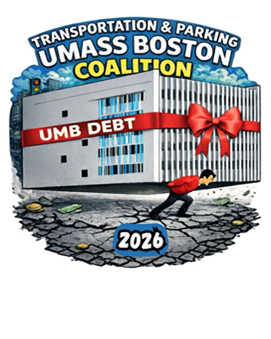
There’s a big difference between UMB and UMass Amherst, though: UMB has added the debt from building the West Garage into the Parking and Transportation budget. This debt is close to $4,000,000 every year. While the current revenues from parking fees are sufficient to cover the staffing, operations, and maintenance of all the parking facilities (as well as pay off some of the annual debt), those revenues are not enough to cover an additional $4 million in debt each year.

The coalition, hearing from many of you, agreed in principle with a method to have small, predictable increases in parking fees each year, and to reduce these periodic large increases every few years. So, we submitted language accepting the idea of an “accelerator” but that limits the amount of the debt we must cover to $2,500,000 annually. In addition, our language proposes capping any increase to parking rates to no more than 0.25% less than the lowest across-the-board salary adjustment received annually by any of the unit members.

Here is what UMB Management’s counter proposal included:

·        Daily Parking Rate: Increase to $18 effective July 1, 2026.

·        Sliding Scale: While they accepted the union’s sliding scale based on income, but for every level they are seeking rates higher than the current rates.

·        Multi-Use Passes: They continue to reject reinstituting a multi-use pass, and only want monthly and semester passes.

·        Public Transit Subsidy: They rejected our 50% subsidy, and only proposed a 20% discount.

·        Accelerator (see Negotiations and Future Rates above): They rejected our language to limit West Garage debt to formula.

Next Steps

The coalition will continue to fight against increases to the daily parking rate, and to demand multi-use passes and an increased transit subsidy.  And we will continue to push back on the accelerator language.

We expect to have a negotiation session within the next month.

What you can do

Sign the petition and tell administration the impact of their proposed cost increase- such as your quality-of-life ability to pay to come to campus on non in person days.

Union Coalition Members

Classified Staff Union: Alexa MacPherson, Jariza Rodriguez and Anna Rose (MTA field representative)

Department Chairs Union: Michael Carr

Faculty Staff Union: Caroline Coscia, Lorenzo Nencioli (FSU Senior Staff), Katie D’Urso (MTA field representatives)

Professional Staff Union: Anneta Argyres, Michelle Browning, Mary Jo Connelly (PSU Staff)

« Previous Page

Log In

Lost your password?

Register

Forgotten Password

Cancel

Register For This Site

A password will be e-mailed to you.

Cancel

Recent Posts

  • Supporting Contingent Women of Color Faculty Initiative
  • Join MTA at Boston Pride this Saturday
  • Reminder June 3rd Parking Bargaining Update: Status of bargaining and what happens July 1st
  • Parking and Transportation Bargaining Update- Meeting on Wed June 3rd, 12PM
  • Nuts And Bolts: Period of Non-Responsibility, Parking And Transportation Update, Know your contract: Enrollment above Cap, Know Your Contract: Phased Retirement, No on 90 Campaign, MTA Summer Conference, and MTA Benefits
  • The Point: President Coscia on FSU’s collective power
  • Nuts And Bolts: Parking And Transportation Bargaining, Support the Bargaining Team, NTT Promotion notification, UCTLT 2026, PRIM Voting ends May 22nd, MTA New Leadership and MTA Benefits
  • The Point: Weapons
  • Dental Insurance. Help Select our Plan Coverage
  • Nuts And Bolts: Digital Content Accessibility Update, Parking Petition Update, NTT change in continuing appointments FTE, Sick time donations, MTA retirement consultant and MTA Benefits