This week’s Point was written by Jessica Holden, Associate University Archivist for Research Services. As always, The Point represents the views of the authors and is not the official position of the FSU.
As an archivist, I often discover uplifting, moving, and exciting pieces of UMass Boston’s history. Moments in our university’s past that are truly inspiring (such as the story of the FSU’s early organizing efforts in the mid-1970s). At other times, I uncover stories that are deeply disturbing, although no less important (if not more so). Today I am sharing one such story: that of Dr. Walter E. Massey, UMass Boston, and what could have been.
In The African-American Experience at the University of Massachusetts Boston: Challenges and Future Directions, published by the Trotter Institute in 1999, Professor of Sociology James Blackwell described the history of the Black Faculty and Staff Caucus (which he founded in the early 1970s, and which is now the Black Faculty and Staff Association) and their efforts to increase racial diversity on our campus. In Dr. Blackwell’s words:
“I organized the Black Faculty and Staff Caucus for the following reasons: My colleagues and I wanted to develop a sense of community among Black professionals in a predominantly white institution. We wanted to institutionalize a mechanism through which persons of color would have a voice in university affairs. We wanted to provide a mentoring vehicle for new faculty, staff and students. We wanted to serve as a force for the continuing recruitment of faculty and staff of color. And, we wanted to be able to attack discrimination and unfair treatment whenever and wherever it occurred.”
As I read through Dr. Blackwell’s lecture, one story in particular left me stunned. He recounted that in the late 1970s UMass Boston launched a search for a Vice President for Academic Affairs. The Black Faculty and Staff Caucus identified a pool of qualified candidates that were people of color, one of whom was a molecular physicist. That candidate said that he would want a faculty appointment along with the Vice President position. According to Blackwell:
“Ultimately, the selection committee decided against offering this position to an African American physicist who was a person of impeccable credentials and high standards! Now, I would like to tell you who he is. Instead of coming here, he went on to become the Director of the famous Argonne Laboratory at the University of Chicago where the atomic bomb was made. Later, he became the Director of the National Science Foundation. Today, he is president of Morehouse College: Dr. Walter E. Massey. UMass Boston once had a chance to get him! But small-minded people decided that they did not want this person of color in that high level administrative position on this campus.”
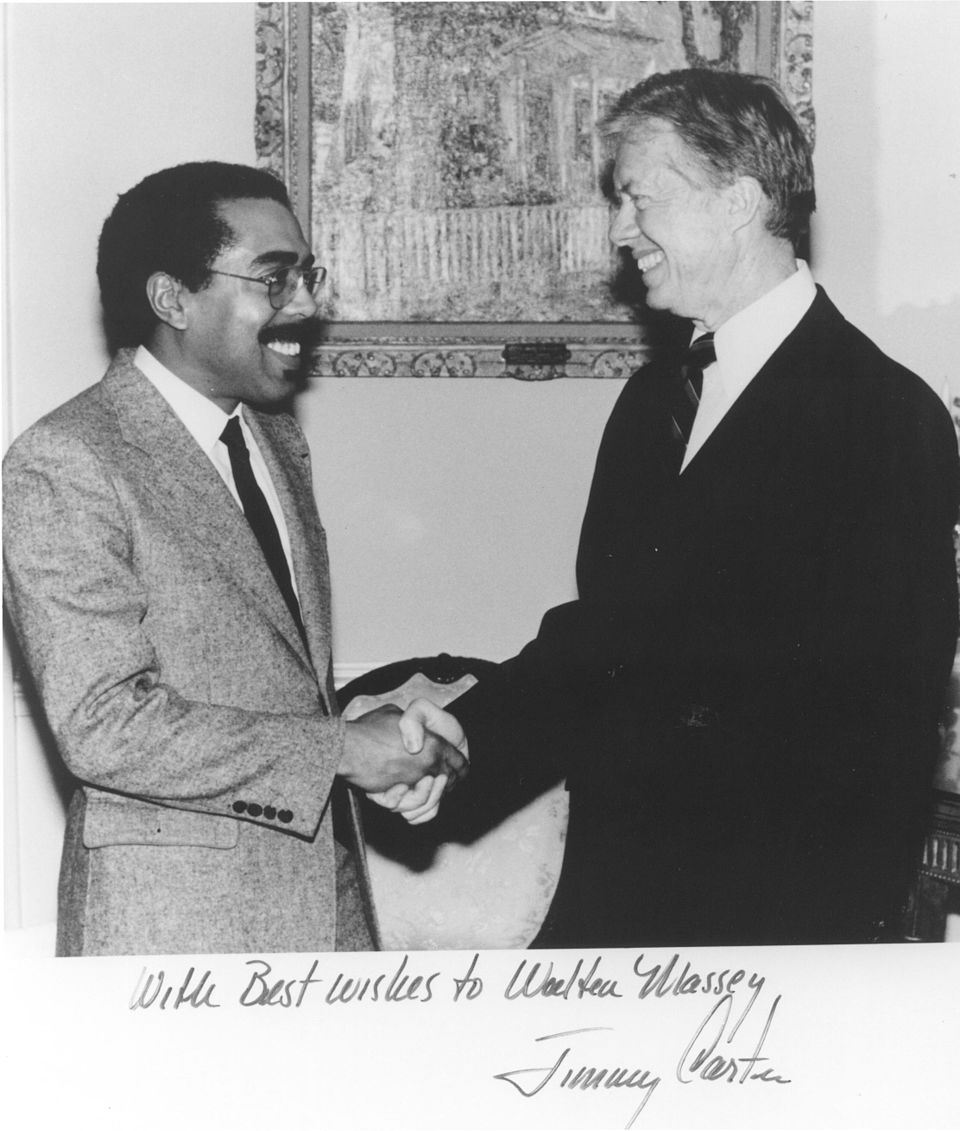
Dr. Massey meets with President Carter at the White House in 1980.
Image courtesy of the Argonne National Laboratory.
What has Dr. Massey done since this lecture was published in 1999? To name just a few of his many academic and professional highlights: he holds dozens of honorary degrees, including from Harvard, Yale, and Brown; he has served on the boards of many prestigious organizations, including the Mellon Foundation, Smithsonian Institution, and MacArthur Foundation; he is President Emeritus of both Morehouse College and the School of the Art Institute of Chicago; he chaired the board of Bank of America after the 2008 financial crisis (about which he published a memoir); and he is the only person to have chaired both the American Association for the Advancement of Science and the Association of Independent Colleges of Art and Design. Currently, he is leading the construction of the Giant Magellan Telescope, a mind-blowingly strong telescope that will be “up to 200 times more powerful than existing research telescopes.” It is difficult to imagine a person with a more illustrious career (beautifully laid out in this timeline from the Giant Magellan Telescope Organization)—and Dr. Massey accomplished all of this after growing up in Mississippi during Jim Crow.
The damage caused by institutional racism is multifold—its systemic nature means that the damage it causes is both immediate and long-lasting: we trace the reverberating effects through the generations. How many UMass Boston students over the past several decades could have learned from Dr. Massey but were denied the opportunity to do so? How many UMB colleagues who would have worked with Dr. Massey never had that chance? In fact, early in his career as an assistant professor at the University of Illinois, Dr. Massey served as advisor to the Black Students Association and as the first chair of the Black Faculty and Staff Association, demonstrating his commitment to his students and colleagues and to racial justice. In a time of widespread attacks on DEI programs in the United States, and as a self-proclaimed anti-racist university, it is important for us to look at the painful parts of our past so that we do not make the same mistakes in our present or future.
The committee for this year’s The Point currently includes Jessica Holden, Healey Library; Nick Juravich, History; Jeff Melnick, American Studies; and Steve Striffler, Labor Studies. If you want to write an edition of The Point, or if you just have an idea, please write us at fsu@umb.edu.