Faculty Staff Union

Representing Faculty Members and Librarians at UMass Boston Since 1976

  • Contact Us
  • Membership Info
  • Executive Committee
  • Contracts & Documents
  • Member Rights
  • Calendar of Events

Spring 26 FSU Vice President Special Election Results

Dear FSU Member,

Voting for the Vice President special election closed this morning at 9AM, and the election results are in.

Congratulations to your newly elected FSU Vice President:

Vice President: Jessica Holden, Librarian IV, Healey Library

(please contact the FSU Elections Committee if you would like details on the final vote tallies).

Thank you to all who voted.

FSU Elections Committee:

Lynne Byall Benson, Senior Lecturer, Women’s Gender And Sexuality Studies

Andrew Elder, Librarian V, Healey Library

Travis Johnston, Associate Professor, Political Science

Rania Said, Assistant Professor, Modern Languages, Literatures, and Cultures
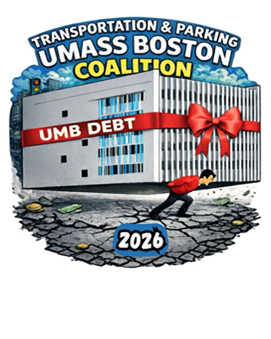
 

Parking Rates: Don’t Be Left Out! Add Your Name

Dear Member,

The Parking & Transportation Petition Deadline is Wednesday, April 29.  The Petition Delivery Rally is Thursday, April 30th. 

Click here to sign the petition

The UMB administration plans to RAISE YOUR PARKING FEES to $18 per day! They continue to resist a multi-use parking pass plan and adequate MBTA subsidies.

What we’re fighting for:

  • No fee increases! Parking fees are ALREADY too high!
  • A 50% MBTA subsidy! Let’s make this UMB a real “green” campus!
  • Bring back the multi-use pass! Stop making people buy passes that don’t fit their work and class schedules!
  • Cap debt burden! Ensure that parkers are not unfairly charged for campus debt

Read more about how our student and multi-union coalition are fighting back in this week’s Mass Media.

To make parking and transportation more affordable at our commuter campus, we need YOUR help on April 30 when we deliver our petition to the Chancellor and UMass Boston administration. Sign up to join us on Thursday April 30 from 12-1pm in Campus Center 03 Ballroom C.

Only by acting together can we win the parking and transit structure that our faculty, librarians, staff and students need and deserve.

DON’T BE LEFT OUT—ONLY 3 DAYS LEFT!  Sign here today.


Nuts And Bolts: Digital Accessibility of Course Materials, The U, Me, Books Event, NTT Promotion Notification, GIC and GLP-1 Medications, May Day Rallies, and MTA Benefit

Dear Faculty and Librarians,

The FSU is you the members, and we need you to inform us when a policy change occurs. To those who reached out about your on-line summer teaching, we thank you.  Please read the Digital Content Accessibility section as it impacts all of us. We will remain diligent specifically about what is required to meet federal regulations and its impact on our working conditions.

Digital Content Accessibility Regulations and You

Background

In April 2024, the US Department of Justice updated regulations to the American with Disabilities Act (ADA) requiring by April 26, 2026, that all web content and mobile apps provided by state (i.e., public higher education) and local government are accessible to those with disabilities.  The regulations set specific technical standards that must be met. What does this mean to you?  All content placed on Canvas must meet accessibility standards.

As you can imagine, the process to implement the new regulation is large and complex. Each of us will need to review all our class materials and learn how to make them accessible.  Fully meeting the deadline for UMB and other government entities was not going to happen.  As a result, last week the Department of Justice extended the deadline to April 2027.

What does this mean for us?  We have a reprieve until Spring 2027 materials.  Yet, ensuring accessibly is still required and something that will take place over the next few months.   The FSU’s monthly Labor Management meeting with Provost Berger is April 28 and this is our first agenda item.  We will provide you with an update on our discussion.

Yes, we have heard from you about certification

Some of you have contacted us about being told you need to be ‘certified’ to teach your summer class, even if you have taught on-line for many semesters.   After some digging, we realized what you were being told is due to the regulation change and what was the April 26th implementation date.

There is no certification process required to convert your materials to teach this summer.

Anti-Racism Grant Recipient Activities (information submitted by grant recipients)

The U, Me, Books Event is Monday, April 27th from 12-2 on the first floor of the campus center!  

This event will feature a free book giveaway for UMB community members with kids in their lives. I’ll be giving away diverse books for readers ages 0-12+, along with book activity ideas, diverse reading lists, and other treats.  The giveaway is open to all students and UMB staff and faculty and hopes to recognize and support all our UMB students who are caregivers or have kids in their lives!    See the attached flyer for more details.

Non-Tenure Track Promotion: Notification Deadline

Promotion to Senior Lecturer and ranks above requires you to inform your chair of your intent to apply for promotion.  The date to submit an email to your chair is Wednesday, May 13th.   Although you indicate your intention to apply for promotion in May 2026, your promotion materials are not submitted until January 2027.

A more detailed email will be sent to non-tenure track faculty including eligibility criteria.

Group Insurance Commission (GIC): Action needed to get GLP-1 medications covered

State Representative Marjorie Decker is sponsoring an amendment to the proposed state budget which would maintain GLP-1 medication coverage for weight management. The GIC Commission voted to eliminate coverage for weight management.

Please tell your state legislator to support the Decker amendment along with other budget amendments aimed at funding public education.  Click on this link https://actionnetwork.org/letters/write-to-your-representative-about-the-fy2027-house-budget/

May Day: International Workers Day is Friday, May 1st.  Join Rallies at Kendall Square and Boston Common

Educators over Billionaires! Join labor and MTA members as we gather at 4PM in Kendall Square and then march to Boston Common.  The Boston Common rally begins at 5PM.  For more information and a list of activities go to https://www.mass50501.org/events/2026-mayday  To learn more about May Day and MTA, go to https://www.massteacher.org/resource-library/may-day

MTA Benefits: Jimmy Fund Scooper Bowl, June 1st and 2nd

At some point the weather will get warm and when that happens, what is better than ice cream. Even better is unlimited ice cream and raising money for Dana Farber Cancer Institute’s Jimmy Fund.  MTA members receive a $3 ticket discount.  Log into MTA Benefits and click on Giveaways & Tickets.

Sincerely,

Caroline Coscia

FSU President

Senior Lecturer II

Political Science Department


Report From the FSU Visa Committee

Dear Member,

As you may recall, during the negotiations for the 24-27 collective bargaining agreement, the FSU Core Bargaining Team (CBT) proposed language that would have created a fund to pay for immigration costs for our international members and their families. The CBT was unable to reach agreement with the Administration on that proposal. We did reach agreement on language to create a labor-management committee that would further examine the issues surrounding immigration costs for international faculty (see contract language below). This committee would have the authority to reach a formal memorandum of agreement.

We, the FSU members of the visa committee, write to provide you with the results of our work (contact the FSU office for a copy of the report). We start by noting that we are disappointed in this result. Our work on the committee began with a continuation of the CBT’s goals of memorializing a fund to cover immigration costs. We held our first meeting with the Administration in early Fall 25 and met multiple times between then and the release of the final memorandum of agreement. Initially, the Administration seemed supportive of this effort. But over the last few months of meetings with the Administration, it became clear that they were not willing to commit to enshrining in the contract any language regarding a fund to cover immigration costs for international faculty. During the course of our discussions with the Administration, we provided multiple alternatives to our initial proposal and expressed a willingness to compromise to reach an agreement. It wasn’t until the committee’s final meeting that the Administration provided us with a suggestion, not in writing. It was made clear that the most they were willing to do was to amend their guidelines to college administrators that would make it clear that transition funds for new hires could be used to cover immigration costs (that language can be seen in the report).

The FSU members of the committee debated whether or not to even co-sign a memorandum of agreement with the Administration. But after some consideration, and after conversations with members of the FSU international faculty caucus, we decided that some small movement in the right direction was better than nothing. That said, we remain committed to the principles that the CBT brought forward via their initial proposal in bargaining and that the FSU members of this committee brought to our work with the Administration. We urge the members of the next CBT to continue to put forward proposals in line with these principles in the next round of contract negotiations, and we urge FSU members concerned about these issues to stay involved and continue to press the Administration to do what’s right for our international faculty members and librarians.

Sincerely,

The Members of the FSU Visa Committee:

Maria Carvajal Regidor, Assistant Professor, English

Miguel Montalva Barba, Assistant Professor, Sociology

Wei Zhang, Professor, Management Sciences and Information Systems

26.6.3 The parties agree to establish a labor management committee for the purpose of researching costs related to visa reimbursements for bargaining unit members. The committee shall be composed of 3 members from the Union and 3 members from the University. The committee shall meet no later than 90 days after the execution of the agreement and shall submit any joint recommendations to their respective bargaining teams by December 15, 2025, at which time the committee shall disband. The parties shall attempt to negotiate a memorandum of agreement as an extension of this collective bargaining agreement


The Point: The Story of Walter E. Massey

This week’s Point was written by Jessica Holden, Associate University Archivist for Research Services. As always, The Point represents the views of the authors and is not the official position of the FSU.

As an archivist, I often discover uplifting, moving, and exciting pieces of UMass Boston’s history. Moments in our university’s past that are truly inspiring (such as the story of the FSU’s early organizing efforts in the mid-1970s). At other times, I uncover stories that are deeply disturbing, although no less important (if not more so). Today I am sharing one such story: that of Dr. Walter E. Massey, UMass Boston, and what could have been.

In The African-American Experience at the University of Massachusetts Boston: Challenges and Future Directions, published by the Trotter Institute in 1999, Professor of Sociology James Blackwell described the history of the Black Faculty and Staff Caucus (which he founded in the early 1970s, and which is now the Black Faculty and Staff Association) and their efforts to increase racial diversity on our campus. In Dr. Blackwell’s words:

“I organized the Black Faculty and Staff Caucus for the following reasons: My colleagues and I wanted to develop a sense of community among Black professionals in a predominantly white institution. We wanted to institutionalize a mechanism through which persons of color would have a voice in university affairs. We wanted to provide a mentoring vehicle for new faculty, staff and students. We wanted to serve as a force for the continuing recruitment of faculty and staff of color. And, we wanted to be able to attack discrimination and unfair treatment whenever and wherever it occurred.”

As I read through Dr. Blackwell’s lecture, one story in particular left me stunned. He recounted that in the late 1970s UMass Boston launched a search for a Vice President for Academic Affairs. The Black Faculty and Staff Caucus identified a pool of qualified candidates that were people of color, one of whom was a molecular physicist. That candidate said that he would want a faculty appointment along with the Vice President position. According to Blackwell:

“Ultimately, the selection committee decided against offering this position to an African American physicist who was a person of impeccable credentials and high standards! Now, I would like to tell you who he is. Instead of coming here, he went on to become the Director of the famous Argonne Laboratory at the University of Chicago where the atomic bomb was made. Later, he became the Director of the National Science Foundation. Today, he is president of Morehouse College: Dr. Walter E. Massey. UMass Boston once had a chance to get him! But small-minded people decided that they did not want this person of color in that high level administrative position on this campus.”

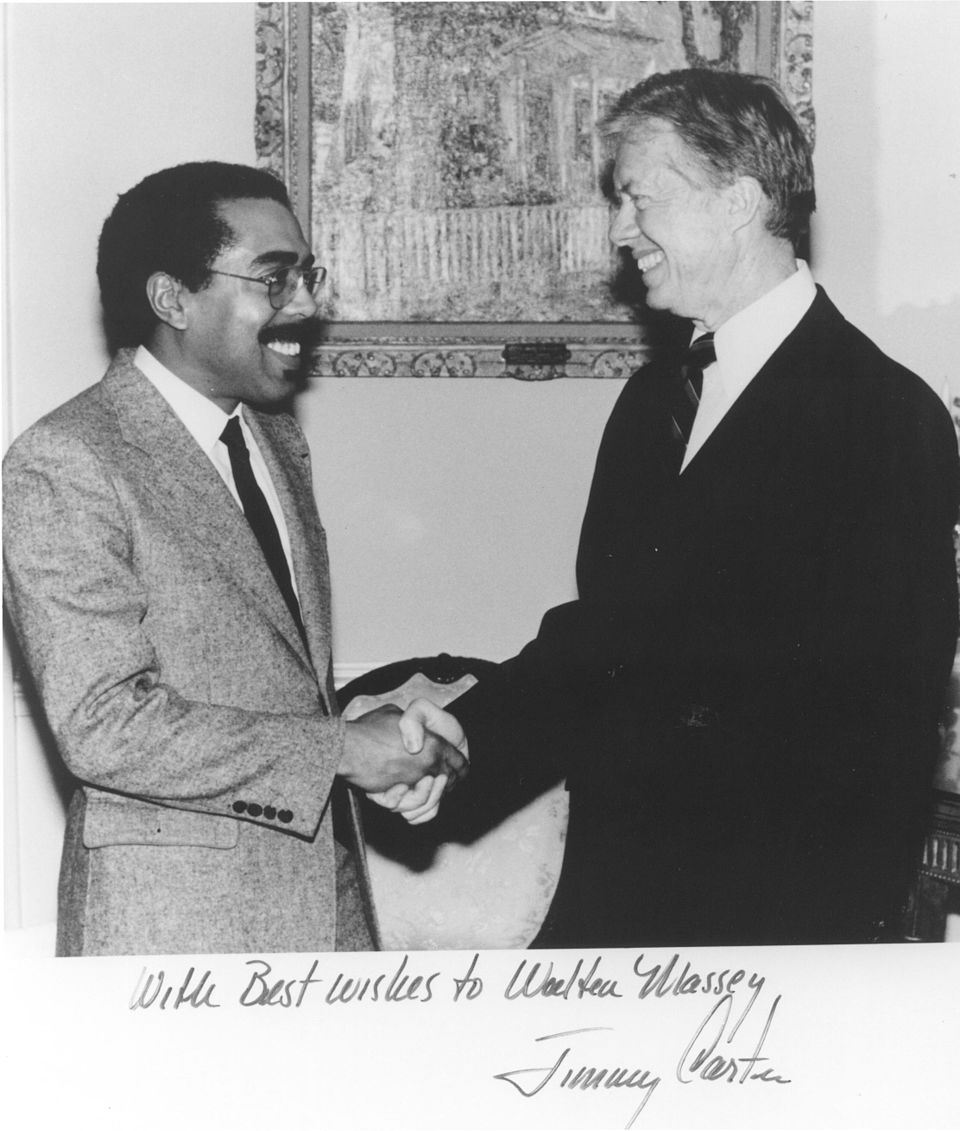
Dr. Massey meets with President Carter at the White House in 1980.
Image courtesy of the
Argonne National Laboratory.

What has Dr. Massey done since this lecture was published in 1999? To name just a few of his many academic and professional highlights: he holds dozens of honorary degrees, including from Harvard, Yale, and Brown; he has served on the boards of many prestigious organizations, including the Mellon Foundation, Smithsonian Institution, and MacArthur Foundation; he is President Emeritus of both Morehouse College and the School of the Art Institute of Chicago; he chaired the board of Bank of America after the 2008 financial crisis (about which he published a memoir); and he is the only person to have chaired both the American Association for the Advancement of Science and the Association of Independent Colleges of Art and Design. Currently, he is leading the construction of the Giant Magellan Telescope, a mind-blowingly strong telescope that will be “up to 200 times more powerful than existing research telescopes.” It is difficult to imagine a person with a more illustrious career (beautifully laid out in this timeline from the Giant Magellan Telescope Organization)—and Dr. Massey accomplished all of this after growing up in Mississippi during Jim Crow.

The damage caused by institutional racism is multifold—its systemic nature means that the damage it causes is both immediate and long-lasting: we trace the reverberating effects through the generations. How many UMass Boston students over the past several decades could have learned from Dr. Massey but were denied the opportunity to do so? How many UMB colleagues who would have worked with Dr. Massey never had that chance? In fact, early in his career as an assistant professor at the University of Illinois, Dr. Massey served as advisor to the Black Students Association and as the first chair of the Black Faculty and Staff Association, demonstrating his commitment to his students and colleagues and to racial justice. In a time of widespread attacks on DEI programs in the United States, and as a self-proclaimed anti-racist university, it is important for us to look at the painful parts of our past so that we do not make the same mistakes in our present or future.

The committee for this year’s The Point currently includes Jessica Holden, Healey Library; Nick Juravich, History; Jeff Melnick, American Studies; and Steve Striffler, Labor Studies. If you want to write an edition of The Point, or if you just have an idea, please write us at fsu@umb.edu.


The Point: Spring Blossoms

This week’s Point was written by Jeff Melnick, Professor of American Studies and former FSU VP.  As always, The Point represents the views of the authors and is not the official position of the FSU.

I was lucky enough to spend a bunch of time in Central Park last weekend and each day I was there I got out for a run around the reservoir.  In the days I was there, the trees ringing the water went from more or less bare to full bloom. The seemingly sudden riot of color was at once its own reward—how many shades of pink are there anyway?—and a timely invitation to think about how much hidden and underground work goes into a “spontaneous” flowering like this.  So in the spirit of the trees, I thought it might be a good moment to offer up a summary of some recent victories in the arena of higher ed labor politics and more general activism. I do not intend to brightside anyone—the daunting realities of war and genocide and the dismantling of our most crucial institutions (including higher ed ones—sad news just breaking at Hampshire College) shadow all our steps.  But times like these demand a purposeful recommitment to optimism of the will.  So, a few inspiring developments to keep you engaged and energized—since I opened with Central Park, I’ll get this started with two New York stories.

***Just over a month ago, contract faculty at New York University voted overwhelmingly to form a union.  This historic vote means that the new local (affiliated with the UAW) is now the largest union of non-tenure track faculty at any private university in the United States.  It took years to get to a vote and the tireless work by organizers at NYU reminds us that it is the daily stuff—the hallway conversations with colleagues, the caucus meetings, the direct action events—that helps us build to the big moments of victory like this.

*** In the category of “thank goodness we have a union,” faculty colleagues at the University of Illinois-Springfield went one step further by going on strike – now for two weeks – because the university administration was not bargaining with the union in good faith and had to the gall to offer raises of only 1%, in effect delivering faculty a pay cut.  Fortunately, public employees in Illinois have the legal right to strike, something the MTA has been trying to win for us in Massachusetts.  The FSU stands with our colleagues in UPI Local 4100! You can send a letter of support for Local 4100 to UIS Chancellor Janet Gooch here, and donate to their strike fund here.

***Our own Steve Striffler has written about the many tentacles of the “Palestine Exception” to free speech and campus organizing around the country—and even here on our own campus.  So it was gratifying recently to see that a New York State Supreme Court justice reversed the “expulsions, suspensions, and degree revocations” of students involved in pro-Palestine campus activism at Columbia University.  In the Columbia case it was especially noteworthy that the president of Student Workers of Columbia-United Auto Workers (the graduate student/worker union) was one of those targeted by the administration and expelled for his political activity.  While there is still plenty of clampdown to fight against, for now it seems possible that we are at an important moment of redress and rebalancing after a long season of authoritarian suppression of campus speech.

***Just last week, non-tenure track faculty teaching in Maryland’s four-year public universities finally won the right to bargain collectively.  After years of lobbying and grassroots organizing, these faculty members saw passage of passage of Senate Bill 6/House Bill 106 which grants them the right to bargain.  In a moment when contingent faculty across the country have become increasingly vulnerable, this is a truly historic expansion of collective bargaining rights to thousands of employees and a major victory that will likely lead to better pay, greater job security, and many other workplace improvements.   It took years and it was worth it.

***Turning back to New York, we are also very excited to report that three of the four fired at CUNY’s Brooklyn College—all punished for campus activism related to Palestine—have been reinstated.  The PSC-CUNY is a remarkably progressive, activist union and has done stalwart work on behalf of its targeted vulnerable members.  The union has vowed to keep fighting on behalf of the final one of the four, and we urge you to have a look at the union’s website for ideas of how we can all support the effort.

***And speaking of reinstatement.  It was deeply heartening to see our students take the initiative and commit to direct and collective action in response to the shameful administrative firing of our wonderful colleague Professor Keith Jones.  The news story here captures only a sliver of the work they have done in support of Keith, and this flowering of student activism on our campus is testament both to that commitment and to the deep connection Keith has forged with his students.

The committee for this year’s The Point currently includes Jessica Holden, Healey Library; Nick Juravich, History; Jeff Melnick, American Studies; and Steve Striffler, Labor Studies. If you want to write an edition of The Point, or if you just have an idea, please write us at fsu@umb.edu


Solidarity Action for FSU Member Keith Jones

As you may be aware, the FSU has an ongoing campaign to overturn the Provost’s decision not to grant Keith Jones, a professor in Africana Studies, continuing appointment. This means his employment ends this semester.

Keith is a fantastic professor who has had stellar annual reviews and is an inspiration to his students. You can learn more about this case here and here. The FSU has filed an unfair labor practice charge on his behalf, but we need to act now to get Keith continuing appointment so he can keep his job here at UMB.

A few weeks ago, the FSU began a petition drive that including posting flyers with the petition link around campus. Maybe you have seen them. The petition got over 1,500 signatures and was delivered to the Provost on April 2. A week later, on April 9th, the Provost informed FSU that his decision stands and that Keith Jones will be terminated after this semester. The petition now has 1800+ signatures. Please consider adding yours!

The FSU needs you to engage in an act of solidarity for Keith, by participating in a collective phone banking and email campaign to let the Provost, Chancellor, and system President know how important Keith is to the UMB community and that he deserves continuing appointment.

Please join on Zoom in one of these dates/times to phone bank (contact FSU or Caroline Coscia for Zoom information).

  • Tuesday April 14, 11 am – 12 pm
  • Wednesday April 15, 10 – 11 am
  • Thursday April 16, 9 – 10 am

Scripts can be seen here and here If you cannot join during those times, you can still call during other work hours, and/or send emails.

From the FSU Organizing Committee to Reinstate Keith Jones


Nuts And Bolts: Upcoming events, FSU Annual Meeting, Sick Leave Bank, Sick Leave Bank Donations, Parking Rally, Anti Racism Grant: Stolen School, May Day Rallies, and MTA Benefits

April 13th to 17th  

Thursday, April 16th, 11AM-1PM FSU Annual Meeting 

Open to dues paying members.

Dear Faculty and Librarians,

This week is our annual meeting. A time to gather with colleagues, meet new colleagues, hear what your union is doing, adopt our operating budget, and provide us with your input. This year we are meeting on Thursday, April 16th from 11:00AM to 1:00PM.  Our annual meeting is only open to dues paying members.  Meeting details and meeting materials were sent to dues paying members on April 9th.

Sick Leave Bank

The other day a member said they heard we no longer have a sick leave bank.  That is false. We have a sick leave bank.  The bank is overseen by a committee- two FSU members and two from administration.

Our contract states: After the exhaustion of personal sick leave accumulation, any member of the Sick Leave Bank shall be entitled to use the Sick Leave Bank for any bona fide illness or disability, effective upon notice to the campus Personnel Office. The granting of such sick leave shall be subject to the same criteria as personal sick leave days and shall be consistent with university policy. (Article 27.3.3. 1.3)

Sick Leave Bank Donations

At any time, a member may donate some of their accrued sick time to the sick leave bank (Article 27.3.3.1.1).  To do so you need to complete a form. To obtain the form, contact Human Resources.

Sick Leave Bank Donations: Retiring Members

To our retiring members, if you wish to donate your unused sick hours, please begin the process around June 1st as the donation paperwork must be completed prior to the end of your employment (August 31st).

Parking Rally, April 15th at 1:45 ISC Atrium

Show administration that a proposed $18 daily rate is unacceptable! Join us in demanding a no daily rate increase, allow for a 30-use pass, and a larger transit subsidy.

Anti-Racism Grant Recipient Activities (information supplied by recipient)

Stolen School: What Desegregation took and one Black Community’s 60-year fight to get it back.

April 29th from 4 to 6PM

We are inviting you to attend a documentary screening and panel event exploring desegregation and its impacts, funded by a UMB FSU anti-racism grant. Please RSVP using the QR code on the attached flyer.

Set in Evanston, IL, a Chicago suburb, Stolen School, confronts the reality that desegregation wasn’t good for everyone. In 1967, Evanston “desegregated” its schools by closing Foster School, the all-Black neighborhood school in the historically Black 5th ward. Since there was not a single school in the 5th ward, children who lived there were bused to at least seven different schools. For nearly 60 years, there’s been no district school in the 5th ward, where the largest population of Black families reside. Stolen School features the voices and stories of Foster School students, 5th Ward residents, educators, civil servants, and activists who describe their devastating losses and chronicle their ongoing fight to get their school back.

Along with documentary Executive Producer Dr. Shannon Clark, UMB faculty and affiliates will explore the film and connect its themes to Boston’s past and present. Ultimately, our hope for this event is that it will strengthen our collective UMB community knowledge and expertise around school closures to be both informed and responsive to larger community needs in our research and service work.

May Day: May 1st Rallies

Join MTA members and labor organizations to rally in support of International Workers’ Day and our fight for full funding of public higher education, a reformed healthcare system, protections for immigrant students, and fair contracts for all.  The rally begins at 5PM on Boston Common.

Recently, GIC removed coverage of GLP-1 drugs for weight loss.  Why? The high cost of coverage. Yet, the makers of these medications have seen skyrocketing profits.  Eli Lilly, the maker of Mounjaro and Zepbound, saw their net income rise to $6 billion. Tell Eli Lilly that profit over people is wrong.  Meet at 4PM on May 1st at Eli Lilly’s office in Cambridge for a rally and then walk to Boston Common.

MTA Benefits: $100 Lowe’s Gift Card

MTA Benefits is giving away three $100 Lowe gift cards.  To enter go to https://www.mtabenefits.com/giveaways-tickets/giveaways

Nuts & Bolts will return on April 27th.  Monday, April 20th is Patriots’ Day, a university holiday.

Sincerely,

Caroline Coscia

FSU President

Senior Lecturer II

Political Science Department


The Point: The Shared Concrete: Coming Together for Parking & Transit Justice

This week’s edition was written by Joseph G. Ramsey, a faculty member in English, American Studies, and the Honors College.  As always, The Point represents the views of the authors and is not the official position of the FSU.

At times like these, when global dangers threaten to overwhelm us and ‘Politics’ often appears as the province of oligarchs beyond our reach, maybe there is something to be said for anchoring in the shared concrete: what’s happening in our own campus backyard, or, more precisely…in our parking garage and lots. Like the much-derided MBTA, parking at UMB bring us together—even as it sometimes drives us to distraction.

What IS happening with parking these days?

Here are 4 short takes (before you run to go teach):

  1. UMB Admin is pushing to raise our daily parking rates, yet again, to $18 per day.
  2. Our campus unions are pushing back. In coalition, (FSU, PSU, CSU, DCU, and GEO), we’re resisting this proposal at the bargaining table.  (Undergrads are organizing as well.)
  3. Admin is also still rejecting our Coalition demand for a flexible 30-use parking pass that could make discounted parking practical for more students and workers, most of whom don’t come to campus 5 days per week.
  4. Admin has finally admitted that giving UMB workers and students some sort of meaningful MBTA subsidy is a good idea. (About time!) However, their proposal for a 25% MBTA discount still falls well short of the 50% our coalition demands.  Our unions are pushing for an MBTA subsidy that moves UMB towards genuine sustainability, one that makes it cheaper to take the T than to drive.

Here is the bottom line: We need FSU members—and UMB students—to raise our voices together in April to make sure we prevail at the table.  So, if you have not already done so, please SIGN AND SHARE our UMB Union and Community Parking and Transit Petition. We plan a mass delivery of this petition on April 30. (Over 1000 have already signed!)

And if you think you can make it to a Standout and Rally for Parking & Transit Equity and Affordability on Wednesday, April 15 (“Tax Day”), 1:45-2:30pm in the ISC, please sign up here,  (and bring your friends!). Let’s tell UMB Admin that the “parking tax” to work here is already too high!

We’re also looking for FSU members and students to share testimony at the bargaining table on 4/15. How does unaffordable parking and transit at UMB affect you? How about your students and community partners?

Finally, if you’re interested in having a small UMB Coalition Transit Organizing team come visit your class(es) sometime in April, to talk with students about the coalition campaign and how to get involved, please email FSU or me directly at joseph.ramsey@umb.edu.  (A visit can be as short as 5 minutes!) We have a great cohort of students, staff, and faculty ready to talk with students about why this matters to our UMB community.

Whatever our job at UMB, we all share the need to travel to this campus—a fact we share with the vast majority of our students, too (residence halls notwithstanding).  This makes parking and transit an opportunity to organize our community, since this affects so many.  If we push together against $18 parking fees (and for better MBTA subsidies), we might just discover some untapped collective power.  And as banal as it might seem, transit justice is a ‘small’ issue that concretizes ‘Big” ones.  By defending affordability at the toll booth, we defend the public mission of UMB, founded, let’s never forget, to make world-class education available to all—not just those with cash on hand to feed the machine.

That’s the short of it.

And now, since this is The Point, for the not so short piece. Below is an edited version of the testimony I gave to UMB Admin at the bargaining table two weeks ago, alongside our all-union Coalition Bargaining Team.  I share it in hopes it may inspire some of YOU to speak at our rally or bargaining session on 4/15, or—even better—to talk with your students about the shared concrete beneath our feet.

Remarks delivered at the UMB Parking & Transit Union Coalition Bargaining Session

3/24/26

Good morning.  My name is Joe Ramsey, and for twelve years I’ve taught here full-time at UMass Boston, in the English and American Studies Departments, as well as in the Honors College.  Among the many classes I teach is a first-year course about “Experiencing Boston,” where students explore the history, literature, and cultures of our city, as an intellectual hub and a center of social change.  When the weather allows, we travel across Boston—often via the MBTA—to help bring the city to life.

Of course, this semester, in a first-year class it has been challenging to pursue our academic learning plan at all.  Since close to HALF of the first-year students I’ve taught had their lives upended as a result of the East Residence Hall flooding and closure, and the resulting mass displacement—whether to the Mt. Ida campus, to local hotels, or, in many cases, back home to family who reside (more or less) in the area: students compelled to commute.  This dorm crisis and the resulting mass transience hit our first-year students HARD.  They’ve been struggling with unexpected costs (for food, housing, travel, and replacement necessities), torn from their newly forged routines and social networks, and have often felt abandoned or disrespected by campus administration’s response.  Many students have confessed that they’ve had their hopes for what the first year of college would be dashed, and many more are reeling with a feeling of abandonment at the hands of those they trusted to care for them. Many first year students are now wondering about how they ended up feeling… left to the wind…

Whether or not that is a fair verdict on their part I submit to you that it is an established emotional fact that requires the utmost attention.  I’ve heard even some of my most outstanding students—campus leaders in their first year—speaking aloud about something they never expected to be considering at this point in their college careers: transferring out of UMB.

How does this relate to the issue of Parking costs and Public Transit?   Here’s the point:  UMB should be doing EVERYTHING it can right now to send the message to students, especially but not only first-year students, that UMB is in fact trying to become a welcoming and accessible place that cares about them, as human beings, both on and off-campus.   Further raising the costs of parking that is ALREADY too expensive in the eyes of most—while doing far too little to reduce the cost of public transit—sends EXACTLY THE OPPOSITE MESSAGE, “adding insult to the injury.”‘ If we want to keep students here and not send record numbers of the first-year cohort packing, we should be working to make campus MORE affordable and transportation options MORE accessible and flexible, not less so.

And what goes for students goes for faculty as well, especially for our lower paid NTT faculty, for whom parking on this campus has become a burdensome and regressive tax just to get to work.  Some of our lowest paid Associate Lecturer faculty are now paying 5% or even 10% of their teaching income JUST TO PARK on this campus!  Such punitive fees further harm our students and campus culture by discouraging faculty from coming to UMB on days when they don’t absolutely have to.  How many faculty members would be meeting with students more often, or attending more campus events, if not for the punitive tax of paying an additional $15 per visit?

Join me for a moment in imagining a counter-factual:

How great would it be if students and employees, upon gaining admittance (or hire), were quickly sent a (free!) MBTA pass before their first day at UMB.  Consider the message THAT would send: “UMB is your gateway to exploring not only our campus but the whole city of Boston.  Your UMB ID unlocks all of Boston for you!  The city is your university!” And also: “Here at UMB we take climate science and reducing carbon emissions seriously!”

As mentioned, I often take students on field trips and site visits for “Experiencing Boston,” and for many students the logistics and expense of travelling across the city via MBTA are already a major hurdle.  Sometimes low-income students miss these field trips because they cannot afford the extra money for MBTA tickets on top of the parking they’re already paying for. I have covered student Charlie tickets out of hand many a time and have watched students scrambling among themselves to cover one another.

We faculty also know very well how increasing backdoor travel costs impact our students, at all levels and across majors: how it puts pressure on students to cut back their days on campus, stacking T/TH or M/W courses to the point of exhaustion (or moving classes online simply to save money on the commute). At the same time, I witness students confessing that despite their interests in a topic, they are unable to attend events on campus—even when those campus events might open fantastic opportunities.  Since, on the days they are here, their classes are so packed that there is no space for attending an event…and on the alternate non-class days, they can’t afford to come to campus (and often are working for wages to pay the rising costs of attendance).  And then we are surprised when so many excellent events on this campus fail to draw a crowd or fill a room?

Whatever class I’m teaching, I never fail to take a moment at some point in the semester to “quiz” my students: How much would they guess it cost to attend UMB full-time when we opened back in 1965?   The Answer:  $100 PER SEMESTER.  Which is to say, only a fraction of what it now costs just to PARK on this campus. Even adjusted for inflation, commuter students these days can easily spend as much to park at UMB as the full cost of tuition back in the day.  What does this say about the retreat of the “public” mission of our campus?

What sort of message are we sending our students (and our workers!) when we fail to heed their protest that things are ALREADY TOO EXPENSIVE and instead further ADD to their daily and weekly expenses?  Are we serious about increasing graduation rates, and first to second year retention rates, and reducing transfers?  Are we serious about faculty retention?  Are we serious about making ours a campus open and accessible to the Boston community?  If so….raising parking fees further (while inadequately funding T-subsidies) is exactly the WRONG action to take.

To be sure, there are many systemic obstacles to university access that are difficult to address: poverty, austerity, racial inequity, histories of oppression.  But transit and parking costs should be an easy one.  I urge UMB Administration to provide more transit support and more affordable parking, for students and employees alike, and let UMB reap the reward of increased student, faculty, and community engagement.

The committee for this year’s The Point currently includes Jessica Holden, Healey Library; Nick Juravich, History; Jeff Melnick, American Studies; and Steve Striffler, Labor Studies. If you want to write an edition of The Point, or if you just have an idea, please write us at fsu@umb.edu


Nuts & Bolts: Upcoming events, FSU Annual Meeting, Know Your Contract: Longevity Bonus, Retiring Senior Lecturer IIs and IIIs, PRIM Board Election and MTA Benefits

April 6th to April 10th

Thursday, April 9th FSU Executive Committee Meeting 11:00AM to 12:15PM

Upcoming Events

Thursday, April 16th, 11AM-1PM FSU Annual Meeting

Final meeting agenda coming April 9th

Dear Faculty and Librarians,

National Public Health Week is April 6th to 12th, which recognizes the importance of public health and its role in the country’s well-being. This is a chance to honor public health workers – nurses, social workers, health educators, epidemiologists, and environmental health officers, all there every day working to make our lives and society better.

Agenda: FSU Annual Meeting, April 16th 11AM to 1PM NOTE: This is open to FSU members in good standing only

The final annual meeting agenda with the proposed budget will be emailed Thursday afternoon.  Items include an update of the past year’s activities, introducing your new Executive Committee members, upcoming MTA activities, adopting our annual budget, and providing us with input on next year’s activities.

Know Your Contract: Longevity Bonus for Retiring Members

Retiring bargaining unit members (TT, NTT, and Librarians) are entitled to 1.5 days of pay for every year of service (see Article 27.8). Retiring members, especially NTT members, should contact Human Resources to verify your years of service.  Payment is made at the conclusion of the academic year.

Commencement Program: Retiring Senior Lecturer IIs and Senior Lecturer IIIs

The names of retiring Senior Lecturer IIs and Senior Lecturer IIIs will appear in the commencement program.  This is new and effective this year.  Many in these ranks have been teaching our students and doing service for over twenty years with some upwards of forty years.

Election: Pension Reserves Investment Management Board (PRIM)

As members of the Massachusetts State Employee Retirement System (MSERS), we elect PRIM board members.  PRIM manages our pensions funds.  The MTA PRIM Task Force is recommending we elect Lenore Palladino, an economist at UMass Amherst.

Saturday, today, or Tuesday—you should receive your mailed ballot. Please don’t miss it—it’s not junk mail.

MTA Benefits: MTA Disability Insurance Open Enrollment Underway
Open enrollment for MTA disability insurance has begun and is now available to all members for a limited time this spring. This important benefit helps protect your income if you become ill or injured. Coverage is guaranteed to be issued, and all members working 18.5 or more hours per week are eligible. Members may enroll in one of three ways: online through self-enrollment, by speaking with a benefits counselor in the call center, or by meeting with a counselor on-site if available in your district. Open enrollment ends May 22. Members are encouraged to schedule a meeting with the call center or enroll online at their convenience.

Sincerely,

Caroline Coscia

FSU President

Senior Lecturer II

Political Science Department


« Previous Page
Next Page »

Recent Posts

  • Nuts And Bolts: Library Update + Ways to Get Involved
  • Announcement of FSU Special Elections for Pre-Tenure Faculty Representative And Non Tenure Track Faculty Representatives
  • Request for Proposals: FSU Anti-Racism Grants
  • Nuts And Bolts: Seeking Bargaining Team Members
  • The Point: What Does an R1 Library Actually Look Like?
  • FSU Welcomes the New Academic Year
  • Conclusion of Parking Bargaining
  • Your Recent Salary Raise + What’s Next for Bargaining
  • Supporting Contingent Women of Color Faculty Initiative
  • Join MTA at Boston Pride this Saturday