| Dear Colleagues,
Hope you’re settling into the rhythm of the semester. We’ve been busy here at union headquarters, seems like every week there’s a new issue to address. |
|
|
|
| Last week the administration announced that the university will be moving from office phones to Microsoft Teams Calling. That saves the university money but does so by shifting the cost of work phone service onto faculty, librarians, and staff. It also blurs the boundary between work and home even further, expecting us to use our personal phones for work (beyond Authenticator) to be reachable for work calls when we’re not in the office. The university can’t change our working conditions without negotiating with us. We are seeking answers from the administration and assessing our options. | |
|
|
|
|
|
|
|
The Point: Ruminations on a Renovation
Ruminations on a Renovation
or, An Ode to Mustard Yellow Walls & Purple Doors
This week’s Point was written by Jason Fasano, an Administrative Assistant in Wheatley Peters Hall and member of the Classified Staff Union. As always, The Point represents the views of the author and is not the official position of the FSU.
In the early 2000s there was an iconic Lebanese indie band that went by the name ‘Soapkills’ – a reference to the perception that Beirut’s post-Civil War reconstruction and beautification initiatives were erasing the physical evidence that the war had ever taken place at all, and therefore a critique of the ways in which this erasure of history was foreclosing necessary conversations about how to reckon with this past in order to move forward as a society.
I can’t help but think of Soapkills as I gaze upon the new coat of stark white paint recently applied to the walls in the upper floors of Wheatley Peters Hall (one of UMass Boston’s ‘heritage buildings’, part of the original campus constructed in the 1970s). What histories are being painted over? What lessons are being forgotten? And perhaps most urgently of all, what futures are being prevented from coming to fruition by this imposed forgetting?
These recent renovations included replacement of dilapidated ceiling tiles, installation of energy efficient light fixtures, and a fresh coat of paint in the corridors of the fourth floor – in other words, the scope of these renovations did not include work inside any of the offices, classrooms, laboratories, or lounge areas where students and employees spend the majority of our time. I do not mean to imply that we do not deserve nice things in Wheatley Peters Hall (the ceiling tiles were dilapidated after all), quite the contrary – I believe we all deserve to spend our time in nice spaces, not merely pass through them (the ceiling tiles inside the fourth floor’s offices and classrooms remain dilapidated).
I believe the misguided priorities regarding the content of these renovations is a direct result of the process through which they were conceived – a process which, to my knowledge, did not involve consultation with any faculty, staff, or students who actually spend time in this area. I often find myself wondering by what metric UMass Boston claims the title of ‘public’ university, when it continuously feels like there is no role for the public in any of the institutional decision-making processes that occur here.
On Thursday May 21st, staff members working on the fourth floor were informed that these renovations would be taking place – and given a one-week deadline to remove anything from the corridors that we’d like to preserve; anything remaining after Thursday May 28th would be disposed of. Notably, within this one-week period, Monday May 25th was Memorial Day (meaning the university was closed), and Wednesday May 27th and Thursday May 28th were the graduate and undergraduate commencement ceremonies (days that tend to be quite hectic). In other words, we were effectively given two working days of notice to accomplish this task.
One might reasonably ask: How hard could removing some old posters from a hallway really be? Recall that this building has been standing since the 1970s, and imagine how much history was hanging on these walls.
As one small example: The fourth floor was once home to the College of Public and Community Services (CPCS), a uniquely innovative school that prioritized serving non-traditional students by advancing a competency-based pedagogy which valued experiential learning and fostered meaningful partnerships with community organizations. CPCS officially closed in 2019 (although its faculty had been raising concerns about its future since long before then), but the hallways remained adorned with framed artwork memorializing various projects and initiatives that the College had overseen during its four-decade existence.
These are the kinds of institutional histories that are at risk of being painted over (or more accurately, being outright discarded) in the course of such beautification initiatives. My concerns about this painting-over of history are not merely about nostalgia for the past, but far more so about what these choices bode for the future of this institution. CPCS was an entity that concretely embodied the ‘urban mission’ that UMass Boston was founded upon – and its closure, and now its threatened erasure, are symbolic of the university’s drift away from this foundational ethos of serving the city’s public good. In 2022 the University officially rebranded (via a $1.5 million-dollar marketing campaign) to adopt the slogan “For the Times” – a phrase that some faculty charge represents an abdication of its obligation to be ‘for the city’, and which I have previously argued is so vacuous it means nothing at all.
But again, I don’t mean to imply that the denizens of Wheatley Peters Hall don’t deserve nice things – our campus is old, crumbling, and in desperate need of repairs and improvements. Nor do I intend to stand opposed to our university’s evolution into becoming something more than what it has thus far been. But I do feel the need to draw attention to the ways in which the idea of ‘progress’ has served to justify egregious harms throughout history, is often predicated upon an implicit hierarchy of better/lesser ways of knowing and being, and has historically been imbued with racialized assumptions about what actually constitutes ‘progress’.
I would therefore humbly suggest the pertinent question we ought to be asking ourselves at UMass Boston is not if we should be pursuing progress in the abstract, but about who gets to define what this ‘progress’ will look like: Progress on what terms? Progress on whose terms? And this question of forward progress is inextricable from how we engage with our past.
If Wheatley Peters Hall really is a ‘heritage’ building, how are we honoring, preserving, and stewarding that heritage?
And if we really are a public university, shouldn’t the public have a say in these conversations? Demanding stakeholder consultation in decisions about which walls to paint might seem like an odd hill to die on, but I believe this is merely a microcosm of a broader crisis of shared governance plaguing our university.
The committee for this year’s The Point currently includes Jessica Holden, Healey Library; Nick Juravich, History; Jeff Melnick, American Studies; and Steve Striffler, Labor Studies. If you want to write an edition of The Point, or if you just have an idea, please write us at fsu@umb.edu.
Nuts And Bolts: Library Update + Ways to Get Involved
|
Announcement of FSU Special Elections for Pre-Tenure Faculty Representative And Non Tenure Track Faculty Representatives
Dear FSU Member,
With three vacancies on the Executive Committee, the Executive Committee of the Faculty Staff Union (FSU) has opted to hold a special election to fill the vacant Pre-tenured Faculty and Non-Tenure Track Faculty seats (see Article III, Section 5 of the FSU bylaws for more on Executive Committee vacancies). The FSU Elections Committee has been charged with running the Pre-tenure Faculty and Non-Tenure Track Faculty special election.
The attached document contains the schedule of election activities including nominations, campaigning, and voting.
Nomination period: Nominations will be accepted during the nomination period: September 18 – September 28. The Nomination Form is attached.
Term of Office: This is a special election to fill the remaining term for one Pre-Tenure Faculty position and two Non Tenure Track Faculty positions. All positions will begin immediately after the election (voting will conclude on October 16).
Voting Platform: For this election cycle, we will be using Qualtrics. Eligible voters will receive detailed information about this prior to the voting period.
The Elections Committee has our own email account, FSU.Elections@umb.edu. Pre-tenure and Non Tenure Track members should watch for election communications to come from this email address.
Please feel free to contact us with any questions.
FSU Elections Committee:
Lynne Benson, Senior Lecturer, Women’s, Gender, and Sexuality Studies
Andrew Elder, University Archivist and Curator of Special Collections, Healey Library
Travis Johnston, Associate Professor, Political Science
Email: FSU.Elections@umb.edu
Request for Proposals: FSU Anti-Racism Grants
Dear Colleagues,
The FSU is pleased to announce the launch of our annual call for proposals to support anti-racism initiatives that seek to collectively transform UMB’s campus culture. This academic year’s funding pool is $50,000. The application deadline is October 16, 2026.
Proposal Guidelines
We encourage faculty and librarians to think about anti-racism initiatives in broad and innovative ways. The goal of anti-racism is to actively challenge, change, and eradicate racism in all of its forms.
Eligibility Guidelines: All members are eligible to apply. Members may not be awarded funding three years in a row. Members may only apply once each funding cycle. Note that funds are intended primarily to support the implementation of on-campus (physical or digital) activities to provide anti-racist teaching and learning opportunities for UMB community members. Engagement with larger Boston-area communities is welcome but should be secondary. Funded projects often have as a major component an event, product, workshop, activity, lecture, or research analysis report that could potentially benefit the UMB community.
Application Process: materials
- Maximum 2-page double-spaced proposal that includes a budget. When creating a budget, note that funds can generally be used for any activities, materials, and events for the campus community. Funds cannot be used for conference travel, gift cards, incentives, or any forms of personal financial enrichment. Under most circumstances, purchases must be made through the UMB Central Business Unit and the costs involving the administration of the grant are the responsibility of the recipient(s).
- A CV for each applicant.
- Submit as attachments to fsu@umb.edu by October 16, 2026.
Application Process: application review
A committee appointed by the FSU Executive Committee will review the proposals. The committee submits to the provost a list of projects recommended for funding. The provost’s office makes the final decision. All applicants will be notified after decisions are finalized.
Funds are available immediately and must be spent by June 30th, 2027.
Nuts And Bolts: Seeking Bargaining Team Members
Dear Colleagues,
With a new academic year, we bring you our first issue of Nuts & Bolts, our weekly roundup of FSU news. This issue focuses on contract bargaining. Our current contract expires on June 30, 2027, which means that this fall we will soon assemble our Core Bargaining Team to negotiate our successor contract (2027-2030). We expect to begin negotiations with the Administration in early spring.
We are looking for members who are interested in joining the team. Serving on the Core Bargaining Team is important, meaningful work in which you play a pivotal role in improving the working conditions for faculty and librarians on campus. Please complete the attached application and email it to fsu@umb.edu by September 28, 5PM. CBT members typically receive a course load reduction (CLR) or stipend for each academic semester in which collective bargaining occurs, as stipulated in Article 5.6 of our contract. Furthermore, serving on the bargaining team counts as university service on your AFR/ALR.
More details about the bargaining process are below. Please reach out to us at fsu@umb.edu with any questions.
Collective Bargaining Agreement (CBA)
The Collective Bargaining Agreement (or “contract”) codifies all working conditions, inclusive of salaries and raises, for all faculty members and librarians at UMass Boston (except for those who hold administrative positions or are department chairs). The contract applies to everyone in the FSU bargaining unit whether they have joined the union or not, though only dues-paying union members can vote to ratify the contract. The contracts are legally binding agreements that are first negotiated by the Core Bargaining Team and the Administration and then ratified by FSU members.
Core Bargaining Team (CBT)
The Core Bargaining Team is the sole group that represents FSU and negotiates the details and language of each new contract with the Administration. The constitution of the team should allow for proper representation of tenure stream and non-tenure track faculty members, including librarians. CBT members attend bargaining sessions and must be available to meet as a team between bargaining sessions.
Bargaining Priorities
The FSU will conduct a member survey prior to the start of bargaining to help us determine our priorities and proposals. In addition to the survey, FSU maintains a running list of issues with and questions about contract language that require clarification. We also conduct meetings with constituent groups to learn about what is important to them that we could work on through the bargaining process.
The Bargaining Process
The CBT and the Administration’s bargaining team meet regularly throughout the duration of the bargaining process. During each session, the teams present proposals and discussion ensues. Counterproposals are often made, usually at the next session. Although we expect to begin contract negotiations in spring 2027, the process usually takes about a year until we have a contract ratified, although it varies. Typical bargaining sessions last 2 hours and are usually scheduled biweekly, with some exceptions.
The Point: What Does an R1 Library Actually Look Like?
This issue of The Point was written by Jason Rodriquez, FSU President and Professor of Sociology, and Jessica Holden, FSU Vice President and Associate University Archivist for Research Services.
In February 2025, the Carnegie Foundation classified UMass Boston as an R1, top-tier national research university, and moreover, as the top R1 university in the United States for its high research access to students across socioeconomic categories. This achievement is a great credit to our dedicated faculty and librarians, who put in the effort to make UMB all it can be and to take every opportunity to involve students along the way. It’s actually remarkable that we have done this, considering the substandard learning infrastructure on campus. By way of example, we want to draw your attention to the intellectual heart of UMB: Healey Library. The library should be a beautiful, modern, and comfortable space for intellectual engagement. But right now, it’s a health and safety hazard that is completely unacceptable by any standard, R1 or not. Consider the following:
1) Elevators. All four elevators in the library, which are original to the 50-year-old building, malfunction on a regular basis. Since just this past January, there have been nearly 30 documented incidents of the elevators failing or working incorrectly, with many of those incidents involving entrapments. That’s about once a week. The elevators pose an immediate danger to the health and safety of the FSU librarians and PSU and CSU staff who work in the building, as well as students, faculty, and members of the public who use the space. While many people are now opting to use the stairs, many others do not have that option, whether due to health conditions, disabilities, or the nature of their jobs—e.g., needing to transport book carts between floors. Some who have been trapped in the elevators have had panic attacks; others have waited more than an hour to be released from the entrapments. Anyone who has taught in the lower level of the library knows that due to the elevators, students are regularly late to class through no fault of their own. The highest levels of the Administration promised in 2023 to fix these broken elevators, and yet here we are. They urgently need to be replaced.
2) HVAC. Like the elevators, the HVAC system is ancient and failing. Ventilation is poor in many areas. Librarian and staff office temperatures are frequently in the high 70s/low 80s, sometimes so warm that people feel ill. The humidity is also far too high in most spaces, which poses a serious risk to the library’s circulating books collection and to our unique and irreplaceable archives and special collections. The faulty HVAC system endangers the human beings and physical library materials in the building, and yet the Administration has not yet acted on the need for a new system.
3) Pests. While pests of various types have been sighted throughout the building over recent years, insects are currently the most common. Library employees have routinely reported cockroaches on various floors, as well as the presence of clothes moths and carpet beetles in one archival storage area. These infestations limit the ability of our librarians, archivists, and staff to support our students and faculty. In the storage area with moths and carpet beetles, for example, the carpet will need to be removed and replaced—a project that the Administration has been promising to start for more than a year. Yet our understanding is that different Admin units are fighting over who will have to pay for it. Earth to Admin: all the money is coming from the same place—just get it done.
Our Administration, to its credit, has in recent years taken on big projects. They’ve built new dorms, reorganized the colleges to be more financially stable and intuitive, redone the entire UMB website, and made a nice green quad. While each project was messy, hard to do, and had its critics, each also, in the end, resulted in a better university. Which begs the question: amid all these much-needed improvements to our campus, when will the Administration invest in Healey Library and why have they not done so already? Safe working conditions are a contractual right (see Article 19.1 of the FSU contract) and a moral responsibility. Of course, if the Administration made all these much-needed repairs, we would merely have a safe, functioning workspace, which is a necessary but not sufficient condition for anything resembling an R1-quality library.
While Healey Library has not been a priority for the Administration, it is a priority for us. We are coordinating on this with student leaders in Undergraduate Student Government, Faculty Council, as well as our friends in the CSU, PSU, and GEO. We call on the Administration to renovate our library. It is filled with dedicated educators, staff, and learners who make Healey Library the academic engine of the campus. Let’s honor that. Let’s make the library beautiful. But first: let’s make it safe, and let’s do that without delay.
Stay tuned this semester for updates on FSU’s support of Healey Library.
The committee for this year’s The Point currently includes Jessica Holden, Healey Library; Nick Juravich, History; Jeff Melnick, American Studies; and Steve Striffler, Labor Studies. If you want to write an edition of The Point, or if you just have an idea, please write us at fsu@umb.edu.
FSU Welcomes the New Academic Year
Dear Colleagues,
Welcome to the new academic year! We especially want to welcome to campus our new faculty and librarians – we hope you find UMass Boston to be a professionally and personally rewarding place to work. Congratulations as well to all our faculty and librarians who were recently promoted. Those are effective on September 1 and include a salary increase as part of our collective bargaining agreement.
We have a new leadership team in place. Jason Rodriquez, Professor of Sociology, is the new President, having most recently served as the Vice President. Jessica Holden, Associate University Archivist for Research Services in Healey Library is the new Vice President, having most recently served on the previous bargaining team. We would like to extend our heartfelt gratitude to our past FSU President, Caroline Coscia, who served admirably in that role for the previous four years. Thank you, Caroline, for all you have done to improve campus life for faculty and librarians. We also have some new members on our Executive Committee and a committed group of volunteer-activists who do important work that strengthens our union. We are thrilled to be working with you and for you.
The FSU Executive Committee meets every two weeks over the semester. In these meetings we conduct routine business to keep the organization running as well as engage in broader discussions about building union power and improving the working conditions for employees on campus. Dues-paying members are welcome to join. The meetings will take place on Sep 15, Sep 29, Oct 13, Oct 27, Nov 10, Nov 24, and Dec 8 from 2-3:30.
This is going to be a big year for the FSU – we will begin bargaining for our 2027-2030 successor contract. Be on the lookout this fall because we will put out a call for bargaining team members and soon afterwards release a survey to faculty and librarians to determine what our priorities will be during negotiations with the administration. Stay tuned, too, for information about various social events that we are planning for this semester. Our union is here to support you, so please reach out to us anytime at fsu@umb.edu. No issue is too small!
Once again, welcome to the new year. We look forward to working together with you to make FSU and UMB all that it can be.
In Solidarity,
Jason & Jessica
Conclusion of Parking Bargaining
Dear Member,
We write to make sure you hear directly from us as to why no agreement about parking fees has been reached. As you know, a coalition of the Faculty, Classified Staff, Professional Staff and Graduate Employee unions has been in negotiations over transportation and parking fees over the past three years. The failure to reach an agreement, we believe, is due to the campus administration’s insistence on treating those of us who drive to campus solely as a source of revenue, without consideration to the harmful impacts that ever-increasing parking fees has on our community and institution.
First, let’s be clear on the facts. Individuals who park on campus collectively pay over $6 million annually in parking fees. The vast majority of this — $3.8 million in 2025 – is paid at the “cash” rate (rather than through a discounted pass) because the passes are priced so that they are too expensive for students and employees who drive to campus fewer than 3 days a week on average. This structure leaves many members of our community paying $15 each time they park on campus.
No other UMass campus, state university or community college charges its students, staff or faculty this much money to park on campus.
The only reason the administration has provided in defense of the extraordinarily expensive campus parking is the desire to have parkers generate sufficient revenue to not only cover the operations of the parking system (which totaled $3.4 million in 2025), but to additionally cover all debt and depreciation associated with all parking facilities. The debt and depreciation for parking facilities alone totaled over $6 million in 2025 and is anticipated to continue to cost about $6 million each year for the foreseeable future.
This is an insupportable position, and, based on our research, one that no other public higher education institution has taken when it comes to addressing campus debt. We understand that parking revenues should cover the costs to maintain parking areas but we consider it to be unethical to require costs to include all current and future debt incurred by the University in having the structures built. It is completely unfair to ask students and employees to bear the cost of such debt.
When we began transportation bargaining in 2023, the coalition put forward a package that offered the University an “escalator clause” with modest, automatic parking price increases in return for a package of transportation benefits that included the following:
- a sliding scale that reduced parking costs for union members who earn less than $50,000;
- 30-use pass with reduced parking fees to reduce parking costs for all union members;
- 50% MBTA pass subsidy;
- Daily rate of $15 (subject to increases according to the escalator clause)
Unfortunately, the administration was only willing to agree to a sliding scale that would have increased parking costs for everyone, even those who earn less than $50,000. They also refused to include a 30-use pass option, would agree to no more than a 20% MBTA pass subsidy, and an $18 a daily rate. At the last session, the University added a proposal to round the escalator increases to the nearest dollar, potentially increasing the parking costs even more.
We have brought our concerns to the administration many times over the years, begging for them to moderate their proposals and their expectations of revenue from parking. But no change in position manifested at the bargaining table.
As a result of not reaching an agreement with the coalition, MOUs signed by the parties in 2025 will go into effect (see MOU 7 and MOU 7A in the FSU contract). During main table negotiations (for our contracts), each union was presented with a proposal to allow administration in each new fiscal year to raise parking rates only if parking expenditure (including debt) exceeds revenues. The resulting rate increase will not exceed the contract’s cost of living increase. We expect the administration to release information soon about how much parking costs will increase on Sept. 1, 2026.
We all know that budgets and financial decisions reflect the values of an organization. Our administration’s position on parking fees shows clearly that it values our students and employees solely as sources of revenue, rather than as human beings who are essential members of the UMB community.
If, at any time, the administration wants to rethink its position, we are willing to recommence bargaining.
Union Coalition Members
Classified Staff Union: Alexa MacPherson, Jariza Rodriguez and Anna Rose (MTA field representative)
Department Chairs Union: Michael Carr
Faculty Staff Union: Caroline Coscia, Lorenzo Nencioli (FSU Senior Staff), Katie D’Urso (MTA field representatives)
Professional Staff Union: Anneta Argyres, Michelle Browning, Mary Jo Connelly (PSU Staff)
Your Recent Salary Raise + What’s Next for Bargaining
Dear Colleagues,
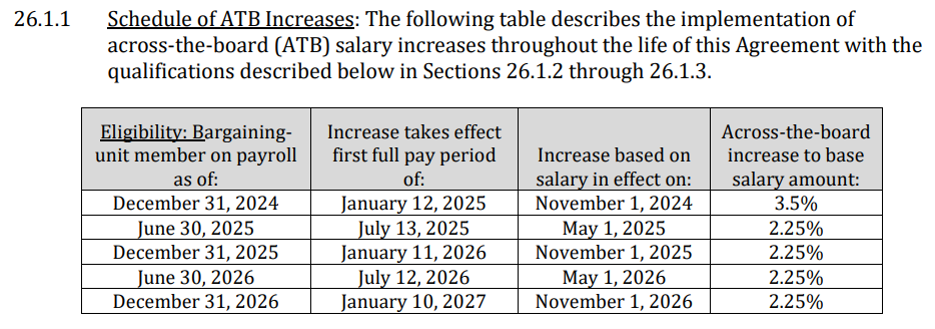
In your most recent paycheck, you should have received a 2.25% raise to your salary. This increase is the result of our most recent contract negotiations, which concluded last year, and is one of five increases totaling 12.5% throughout the life of the FSU contract (see the table below). Our next bargaining cycle is scheduled to start this fall, so keep an eye out for information from us about how to get involved as we continue pushing for better working conditions and higher salaries for all our members. Please reach out to us at fsu@umb.edu with any questions.
Quinn/2/81C
UMass Boston
100 Morrissey Blvd.
Boston, MA 02125
(617) 287-6295 | fsu@umb.edu